

NMLA Seminar: Stakeholders urge FG to cut tariffs on vessels acquisition by shipowners
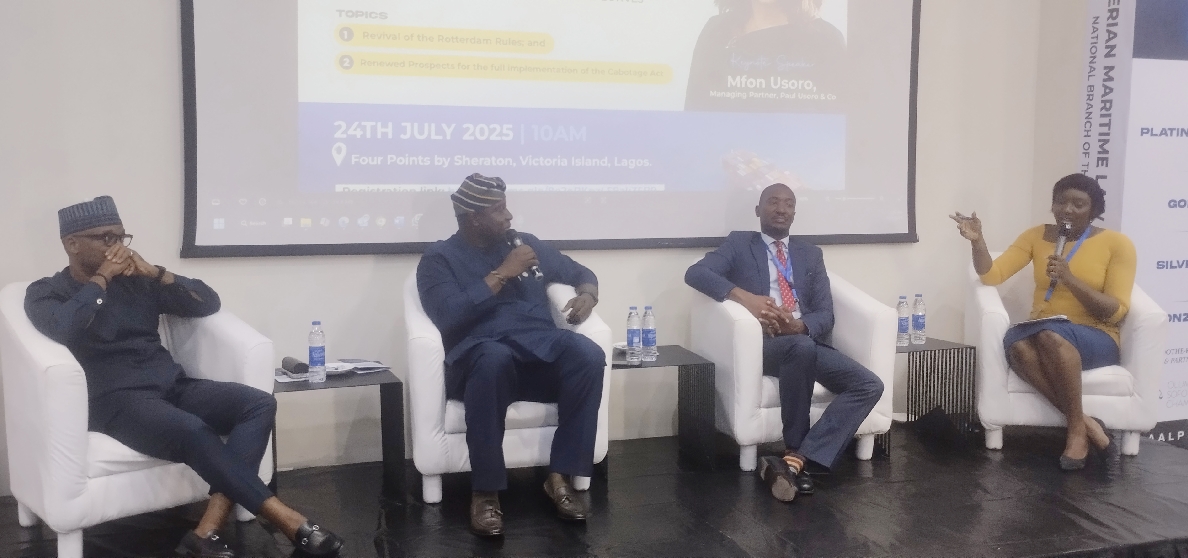

The Federal Government of Nigeria has been urged to cut down the high Customs tariffs on vessels acquisition and ensure that such vessels are purposely-built as the Nigerian Maritime Administration and Safety Agency (NIMASA) reiterated its readiness to implement the Cabotage Act fully and ensure the disbursement of the the Cabotage Vessel Financing Fund (CVFF) as directed by the Minister of Marine and Blue Economy, Adegboyega Oyetola.
Key port stakeholders – Captain Ladi Olubowale, President of African Shipowners Association (ASA), Barrister Adedoyin Afun, Partner, Bloomfield LP, and Mr. Jibril Abba, Executive Director, Cabotage and Maritime Service, NIMASA, stated this while discussing “Renewed Prospects for the Full Implementation of the Cabotage Act” at the 2025 One-Day Maritime Law Seminar held on Thursday, July 24 in Lagos.
The theme of the seminar, organized by the Nigerian Maritime Law Association (NLMA), was “Lens into the Future of the Shipping Industry: National & International Perspectives.”
CVFF vessels must be purposely built
In his contribution, Captain Ladi Olubowale, ASA President, said Nigeria must prioritize her fleet strategy and ensure that vessels acquired with the CVFF loans are purposely built that can grow the Gross Domestic Product (GDP) of the country.
According to him, “We have been an advocate for strategic fleets, and when we talk about strategic fleets, these are fleets that are needed in our industry. And understanding there are the two parts, the service vessels and the trading vessels. So as a nation, if we are looking at growing our own fleets, we should be looking at our trading vessels.
“And when we talk about trading vessels, these are vessels that actually drive GDP of a country. These are vessels that actually drive things as well. So, when we look at it holistically, we are looking at where do we stand as a nation.
“We need strategic vessels that can cross across all. We need tanker vessels, we need feeder vessels, we need fishing vessels, we need vessels that can actually trade in Africa and within ourselves.
“How do we get that? How do we maintain those vessels? What is our maritime infrastructure? So with all those vessels, those are strategic vessels, and they cross across all. I mean, when this is done, we equally have to tackle issues concerning crew mining.
What a feeder vessel does is to pick container from one place to another. The knowledge gap we have in countries is wide, do we have knowledge about specialised container vessels or referred vessels? When you talk about tanker vessels, you still have people in this country that still have that capacity and experience. But when you talk about specialised vessels that can trade, even in practice of international trade, there’s a knowledge gap in that space that we need to build on.
But all this is part of the ecosystem of the maritime infrastructure. Once you have one, it leads to another as well. So we need to build infrastructures 100%.”
On what makes a vessel commercially viable under today’s contracting environmental, the ASA President said “Well, vessels are the back end of every trade. You don’t just go to the market and buy a vessel. They should be in trade properly as well. For instance, now we have a very big opportunity in Nigeria with Dangote.
“Presently now, Dangote is using Angola fleets to deliver oil from the oil terminal to the refinery. None of Nigeria has a street smart vessel. We don’t have.
“How do we play from there? So until we begin to own, play in our own field. And we all know what the art is. Owned by Nigeria, built by Nigeria, flagged by Nigeria, ruled by Nigeria.”

Cabotage Act amendment to address gaps
In his submission, Mr. Jibril Abba, who was represented by Mr. Abdulmumuni Dirisu, Director of Legal Services, informed that the Cabotage Act had been amended by the Senate but remains the House of Representatives, saying that the amendment was necessary to align it with the current realities and needs of the industry, and also bridge some gaps identified, particularly the waiver administration.
Related Posts

“As we speak, it (the Cabotage Act) is before the 10th National Assembly. The House of Representatives will pass it, and it is just awaiting concurrence from the Senate. I will mention that we are equally corresponding, looking at the guidelines, because we observe gaps.
“Once the bill is passed, of course we will conclude the guidelines so its work that is ongoing. I’m sure that another interesting aspect is the directive of the Honourable Minister of Marine and Marine Economy, as it has to do with the distribution of the CVFF. For NIMASA, it is a directive, and we are resolved, and we are determined to implement that directive.
On waiver, Abbas has this to say: “The issue of waiver, as it is, has to do with the approval of the Honourable Minister, and what, of course, is the responsibility of NIMASA in processing of waiver?
“What we have done is to bring it home, bringing it home so that NMASA, being the agency that is responsible for processing the waiver application, should see it from the beginning to the end. And that is one area that is very important. And if you look at the CVFF itself, it is directed now at acquisition of vessel.

Customs tariff on vessels too high
Adding a legal voice to the discussion, Barrister Adedoyin Afun, Partner, Bloomfield LP, said the Customs tariffs on vessels acquisition are too high as this discourages acquisition of new vessels and therefore called for a reduction in the Customs tariffs.
“Customs needs to review its tariffs. I learned customs is trying to review some of their tariffs. It will be helpful if we raise up this issue that waivers should be given, or tariffs should be lower.
“Honestly speaking, most of the vessels that are appraised and take advantage of other opportunities of Nigerians have cheaper costs of financing. And they are operating under a less favourable customs regime So we need to look at this,” said Afun.
On challenges that might likely to prevent the full implementation of the Cabotage Act by NIMASA, Afun said “the bill, I’ve reviewed it, seen it has very interesting things. Some I agree with, some I don’t agree with. As I said, it is expanded to capture infrastructure.
“The only challenge is that, if the bill is passed as it is, we need to have a strategy as to how the disbursement from the CVFF will be. It will be unfair to shipowners who have put funds together and then we start disbursing to parties that have not done that.
“The bill, interestingly, has dealt with the issue of waiver. It has expressed provision that there is a local content requirement.
“So what the law has done, what Bill to do is to create a platform for NMASA to build guidelines for waiver requirements. The Local Content Act has actually helped to push that local content narrative. I am sure NMASA will build on and guidelines will follow there too. Most of the provisions in the bill, in the current act which touches upon minister, has been assigned to NIMASA.
“Because in reality we know that waivers which is required to have the minister to grant, it’s always been NIMASA that grants it. So they have addressed that lacuna accordingly. But if this bill goes through, there will be a whole new enforcement.
“There is something else we definitely need to capture. The bill now seeks to allow foreign mortgages to be accommodated. The registration of foreign mortgages has to do with the issue of mortgages on vessels, which we are trying to creatively accommodate financial institutions there to. It’s still unclear as to what the intention is, but all in, the bill is trying to cure a lot of the issues we have.”
He said Nigeria could not build vessels without reducing tariffs on steel. “There is another school of thought that’s arguing that the major part of building a vessel is steel. So how can you say you want to develop a build without having the policy that allows either free importation of steel to support that angle, or something that works, or you develop your steel area. So we need to look at the root causes.”