
Dredging War: Companies in the Netherlands, Belgium and Europe are losing intensely to Chinese competition

By Gboyega Oni
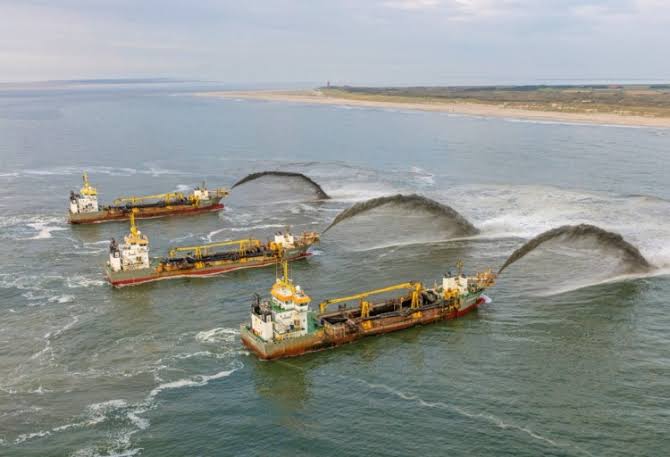
There is an intense war ongoing between dredging companies in Europe and dredging companies from China, Indian and the Middle East over global dredging market shares.
Dredgers from the Netherlands, Belgium and Europe have accused dredging companies from China, India and the Middle East of under bidding thus undermining fair competition in the sector.
Crying out loudly, the European dredgers said that, despite their cutting-edge technology over dredgers from China, India and the Middle East, they are losing market shares heavily to them because they are being funded by their governments, which is giving them ample opportunity to rapidly gaining market share in global dredging markets.
Jeroen de Graaf, Director of NMT-IRO, an association of companies in the Dutch maritime manufacturing and offshore energy industry, pointed out this development plaguing the industry in the Netherlands, Belgium and Europe in a report issued by the NMT-IRO.
Michel Revet, Team Lead Communications of NMT-IRO, made the report available to PortNews in Lagos.
The report, warning of increasing Chinese competition, states thus: The Dutch and Belgian dredging industry is of strategic importance to the economy, water safety, and energy transition in both countries. This is evident from the new report “Future Scenarios and Strategies for the Dredging Sector in the Netherlands and Belgium”, an initiative by trade association NMT-IRO and Erasmus University Rotterdam. While the sector is globally renowned for its expertise in maritime civil engineering, it is now under significant pressure due to growing competition, particularly from China.
The dredging industry in the Netherlands and Belgium stands at a decisive moment. The right mix of innovation, collaboration, and talent can turn today’s challenges into tomorrow’s opportunities.

Key insights from the report:
Strategic ecosystem: The dredging sector is a crucial link in protecting low-lying areas, ensuring accessibility to the ports of Rotterdam and Antwerp, and constructing offshore wind farms.
Essential for water safety: With one-third of the Netherlands and large parts of Flanders below sea level, a robust dredging sector is vital for coastal defence and maintaining inland waterways.
Economic engine: The sector supports over 350,000 jobs annually through critical port and infrastructure projects.
Increasing geopolitical pressure: State-backed competition from countries such as China, India, and the Middle East is rapidly gaining market share in global dredging markets.
Related Posts

According to Jeroen de Graaf, “The dredging sector is of strategic importance to the Netherlands and Belgium. It is about much more than economic impact; our sector plays a crucial role in determining how resilient and competitive we are internationally. If we do not invest together in innovation, talent, and a stronger maritime ecosystem, we will lose our advantage to players like China, who have already made significant strides in this area.”
The report explores three possible future scenarios for the sector:
Green scenario – European dredging companies remain leaders thanks to innovation and sustainability.
Teal scenario – Innovation continues, but within more regional, protected markets.
Brown scenario – Protectionism and resource scarcity dominate, leading to a loss of international competitiveness.
NMT-IRO therefore called on the government, industry, and knowledge institutions to collaborate on innovation, and smart investments in people and technology. By building a future-proof, sustainable, and resilient sector, the dredging industry will not only remain relevant but will also continue to lead the way.
In an interaction with PortNews, Michel Revet, NMT-IRO’s Team Lead Communications, affirmed that Dutch and Belgian dredging companies – and European players more broadly – are among the most technologically advanced in the world but companies from these regions – China, India and the Middle East – often benefit from significant government support, enabling them to underbid European competitors on international tenders.
According to Revet, The Netherlands and Belgium are global leaders in maritime civil engineering, with cutting-edge innovations such as autonomous dredging vessels, advanced digitalization (including AI and digital twins), and world-class expertise in sustainable solutions like nature-based coastal protection and offshore wind infrastructure.
The pressure from China, India, and the Middle East stems primarily from a different dynamic:
State-backed financing and subsidies: Companies from these regions often benefit from significant government support, enabling them to underbid European competitors on international tenders.
Protectionist policies: Certain markets are increasingly closed to foreign competition, favoring local or state-linked companies.
Strategic long-term industrial policy: Some non-European countries implement coordinated strategies that combine industrial, financial, and geopolitical goals, something Europe is only now starting to address more structurally.
“This does not imply a lack of capability within Europe, but rather highlights a risk that European dredging companies could be outcompeted if they are forced to operate under stricter regulations and with less public financial support than their global competitors,” said he.
Revet noted that the danger for Europe lies in the potential erosion of industrial sovereignty:
Loss of strategic autonomy in dredging and water infrastructure.
Dependence on non-European players for critical projects like port access, coastal protection, and offshore energy infrastructure.
A potential weakening of Europe’s capacity to defend against climate risks (e.g., sea level rise) and secure supply chains via resilient maritime infrastructure.
“In response, the sector in the Netherlands and Belgium calls for a stronger industrial policy at European level, combined with targeted investments in innovation, talent development, and international competitiveness,” he submitted.