
FG urged to undertake key maritime reforms to make Nigeria competitive among shipping nations

The Federal Government of Nigeria has been urged to urgently undertake some key maritime reforms to avert the nation losing her place in the international shipping trade arena.
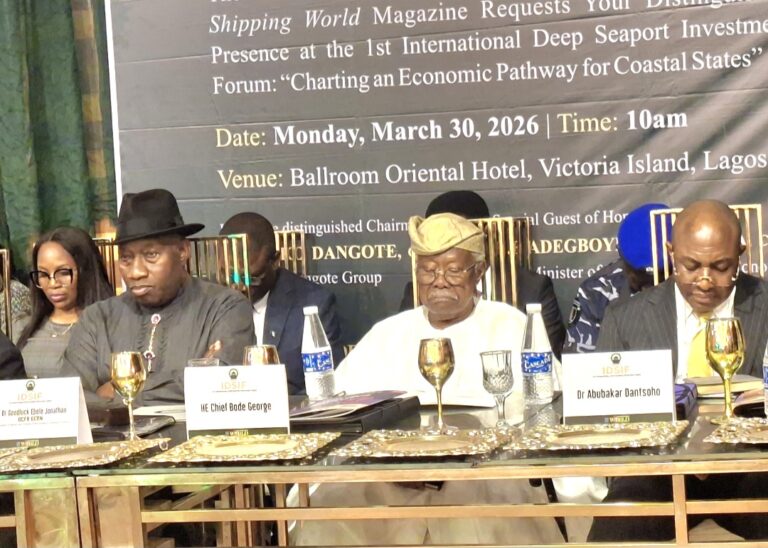
Top Nigerian leaders and industry chieftains, including former President Goodluck Jonathan, gave this warning at the 1st International Deep Sea Port Investment Forum (IDSIF) in Lagos recently.
The forum was convened by Elder Asu Beks, a seasoned maritime journalist and CEO of Maritime Media Limited, publisher of Shipping World magazine.
Speaking, Former President Goodluck Jonathan, who attributed the collapse of the Nigerian National Shipping Line (NNSL) to costly strategic missteps during a critical transition in global shipping, said the mismatch between Nigeria’s investment decisions and global industry realities weakened the viability of the national carrier.
“When the world was migrating to container shipping, which required deeper vessels, Nigeria invested in outdated ships that other countries were discarding. After acquiring them, they could not operate effectively, and the Nigerian Shipping Line collapsed,” Jonathan said.
He argued that Nigeria must ensure that future maritime investments align with international shipping practices or risk repeating the same mistakes.
In his turn, Chief Bode George, former Chairman of the NPA, warned against the dangerous concentration of port infrastructure in Lagos. “It cannot be right to concentrate all your infrastructure and resources in one place. What is happening in the Strait of Hormuz now is a wake-up call. Who knows what could happen tomorrow?” he cautioned.
Chief George called on the Federal Government to diversify port development across the country and called on President Bola Tinubu to sign the Nigerian Ports and Regulatory Authority (NPERA) Bill. He also insisted that the rehabilitation loan secured from Britain should be deployed beyond Lagos, ensuring balanced growth across Nigeria’s maritime landscape.
Related Posts


Representing the Minister of Marine and Blue Economy, Adegboyega Oyetola, NPA’s General Manager for Corporate and Strategic Planning, Seyi Iyawe, outlined the government’s commitment to a green port development strategy.
We are embracing green port philosophy and moving away from conventional ports. Deep seaports are important, but hinterland connectivity is critical. With the Nigerian Single Window now launched, we must develop automated and environmentally friendly ports,” he said.
He explained that government agenda is anchored on three pillars: modernisation, automation, and sustainability. The Lekki Deep Seaport was cited as a model of this new approach, designed to integrate Nigeria into the $3 trillion AfCFTA market.
While many speakers championed deep sea port development, former NPA Managing Director Bello Gwandu offered a cautionary perspective.
There is nothing worse than having a port that is not patronised because cargoes cannot move out. Nigeria does not need deep seaports; what we need are international ports,” he argued.
Gwandu’s intervention highlighted a critical debate about whether Nigeria should prioritize deep sea facilities or focus on building well-connected international ports with efficient hinterland logistics.
Convener, Elder Asu Beks explained that the forum had been years in the making, stressing the urgency of developing deep sea port capacity to stop Nigerian cargoes from being diverted to neighbouring countries.
He commended President Tinubu for creating the Ministry of Marine and Blue Economy but urged him to sign the NPERA Bill to empower the Nigerian Shippers’ Council as regulator.