
Four percent FOB raise, the Customs conundrum

When a nation outsources every revenue-spinning resource and commonwealth to foreigners and ghostly investors in the name and guise of privatisation, her people would lack, starve and suffer inevitably.
Successive Nigerian governments have sold off or given out, in decades leases, some for as long as 45 years, Nigerian ports, electricity generating set ups( NEPA) aluminium, rolling mills, factories, lands, and so on.
Nigeria is even now on the cusp of giving out the entirety of its aviation industry to foreigners in a cloudy concession programme that has been contested in court.
A nation such as this is in a quandary. Its civil service is in trouble, it would be under severe pressure to perform and generate vital revenues to run government and meet civic responsibilities.
This is the mess in which the present government of Asiwaju Bola Ahmed Tinubu is mired. It is ever needy of revenue for finances. And where else to turn to than the oil and gas industry, the maritime industry and the Nigeria Customs Service?
That is the present harrowing dilemma of the Nigeria Customs Service, the nation’s steady cash cow.
This is the root of the 4 percent FOB increment by the Nigeria Customs Service, which has been condemned and rejected roundly by virtually all stakeholders in the Nigerian freight forwarding industry.
From the Association of Nigeria Licensed Customs Agents (ANLCA), National Association of Government Approved Freight Forwarders (NAGAFF) to notable and well-meaning individual licensed customs agents like Dr Kayode Farinto, Dr Segun Musa, Dr Eugene Nweke, Mr Bob Chukwuma Hyacinth and Mr Peter Cole, the increment has been described as unsavoury, punitive and self-destructive.

For Peter Daniel, a licensed customs agent and ship handler, cargo volumes and ship throughput have reduced drastically such that manufacturers are barely managing to keep afloat. “Government and Customs should reconsider this new increase. As things stand, it is almost impossible for importers and manufacturers to cope. People’s purchasing powers are weak, and it is affecting consumption and production. This 4 percent would raise inflation and hardships further. Customs will even lose more revenues. I advise that government and customs do a second thought and withdraw this increment, ” he noted.
Bob Chukwuma, CEO of King Shipping which operates in Lagos and Ghana, said Nigeria’s economy, contrarily, would suffer a regression if the 4 percent is not withdrawn immediately because other west African countries would capitalise on it to increase smuggling to Nigeria. He, however, praised President Tinubu for his staunch approach to fighting corruption.
Speaking to PortNews on this development, Dr. Segun Musa, Managing Director of Widescope, said CISS is illegal and fraudulent, pointing out that the collection has since outlived its purpose as the Nigeria Customs Service now performs cargo inspection.
Musa noted that constant increase in cargo duties is an indicator that the national economy is not doing well and has driven away investors, maintaining that freight forwarders should have gone to court to challenge the validity of CISS.
“CISS is a fraud. It is illegal. Where does the money go? And who shares the money? EFCC should investigate several trillion of Naira collected in the name of CISS” said Musa.
In his own reaction, Dr Kayode Farinto, CEO of Wealthy Honey Investment Limited and a former Acting National President of the Association of Nigerian Licensed Customs Agents (ANLCA), knocked the Customs over the increment, pointing out that the increment would lead to increased costs of goods and services, eventually harming the economy and innocent Nigerians.
Farinto called on the Nigeria Customs Service to give a grace of 90 days to sensitise Customs brokers before implementing the 4% CISS charge.
He acknowledged that the increment was not illegal, as the provision for the 4% charge is stipulated in the Customs Act 2023, Section 18, allowing the Customs Service to collect 4% of the Free-On-Board (FOB) value of imports for the purpose of financing its modernization projects.
Farinto maintained that the Customs’ manner of introducing and implementing the new duties was contrary to Section 23 of the same Act, which requires that the public and stakeholders must be notified before implementation
He insisted that 4% increment was imposed without creating the necessary awareness to the trading community, as required by law.
Farinto called on all Customs brokers to boycott port activities in protest of the increased charge and maintained that brokers’ bodies would petition the Presidency to ensure that this policy is properly implemented.
Related Posts

Also, speaking on the development, Dr. Eugene Nweke, Head of Research, Sea Empowerment and Research Center (SEREC), pointed out that the Customs is legally empowered by its 2023 Act to collect 4% of the Free-On-Board (FOB) value of imports for the purpose of financing its modernization projects.
Nweke averred that the increment has a lot of far-reaching implications including delays and congestion, increased costs, loss of revenue, saying “In the light of this, the implications of this situation are significant, as many cargo undergoing duty payment and clearance processes are presently trapped across customs ports.”
According to him, this may lead delays and congestion at customs ports occasioned by uncertainty and confusion surrounding the 4% charge.
Increased Costs: The imposition of a 4% charge on CIF value may increase the overall cost of imports, which may be passed on to consumers.
Loss of Revenue: The unilateral implementation of the 4% charge may lead to a loss of revenue for the government, as importers may seek to avoid the charge by using alternative routes or modes of transport, and thus, the fear of increasing smuggling activities may be inevitable.
Damage to Industry Reputation: The imposition of a 4% charge on CIF value without proper notification and circular may damage the reputation of the customs authorities and the industry as a whole, undermining trust and confidence in the system, especially, by foreign investors.
He noted, “the situation on the ground is critical, as many cargo are trapped across customs ports due to the uncertainty and confusion surrounding the 4% charge.”
The SEREC boss advised the customs authorities to take immediate action to address this situation by providing clarity on the implementation of the 4% charge, including the basis for calculation and the effective date; issuing a circular to inform importers and customs brokers of the changes to the customs regulations, and engage importers, customs brokers, and freight forwarders on how to address their concerns and provide guidance on the new regulations.
“In conclusion, 4% FCS is a legislated fee as enshrined in Part V, Section 18 of the Customs Act 2023 which provides a framework for financing the operations of the NCS. The provisions establish a minimum revenue stream from import duties, user fees, and other sources, while also emphasizing the importance of transparency and accountability in the determination of these fees and regimes. The implications of these provisions are significant, as they affect the revenue generation and operations of the NCS, as well as the broader economy,” said he.
Hurt and harried by the slew of attacks by stakeholders, customs management hurriedly issued a well couched statement signed by its National Public Relations Officer, Assistant Comptroller of Customs Abdullahi Maiwada, on Wednesday 6th February which tried to explain and justify the new increment as a throw up from NCS Act 2023.
This statement not only justified the 4 percent increase but only revealed the trauma of helplessness and voicelesssness borne by an age-old Customs organisation under the swatchbuckling, overbearing, and god-like successive Abuja political leaders.
Do not blame the Customs.
In the Nigerian Customs Service, memos and every recommendation of a parliamentary Act are sacrosanct, even when circumstances and reality of times starkly suggest or reason differently. No civil servant dare raise a corrective note or voice to the contrary.
Since the inauguration of the Bola Ahmed administration in 2023, the only route Nigerians have travelled is Northwards. By presidential fiats, subsidies were removed from petroleum products, pushing prices up by about 800 percent. The Naira was also devalued by some 500 percent. The fallout is an unprecedented galloping inflation that has exacerbated poverty and unleashed indescribable hardships on the populace, such as never experienced before in Nigeria’s history.
Do not blame the Customs, but the 4 percent increment will reflect in the cost of living by another 4 or more percent because local and imported products all react to these increments commensurately. Yam, garri, dry fish, imported fish, rice, beans, toothpastes, apples, condiments beverages electronics, RoRo, even house rents will all react to the 4 percent increment.
Do not blame the Customs, but port stakeholders would experience torrid sessions trying to convince importers to part with more money to pay as duties to Customs. In fact, the calamitous effect may be that both the importer and his clearing agent may go under, in the face of this strangulating economic situation.
Where is Shoprite? Where are Guinness, Tower Alumnium, Dunlop, and a long list of others? All of them blamed the prohibitive costs of clearing cargo at the ports, among others, for their decision to exit Nigeria.
The searing fact is that most of these companies have only relocated to neighbouring West African countries from where they have continued to service the huge Nigerian market. Nigeria is essentially a market, and no trader would let go of a 200 million strong market. In other words, smuggling across the West African/ Nigerian borders will wax stronger, going forward. Sure, the Customs and Nigeria will lose trillions to neighbour countries and smugglers as a consequence of our government’s sheer arrogance and impunity.
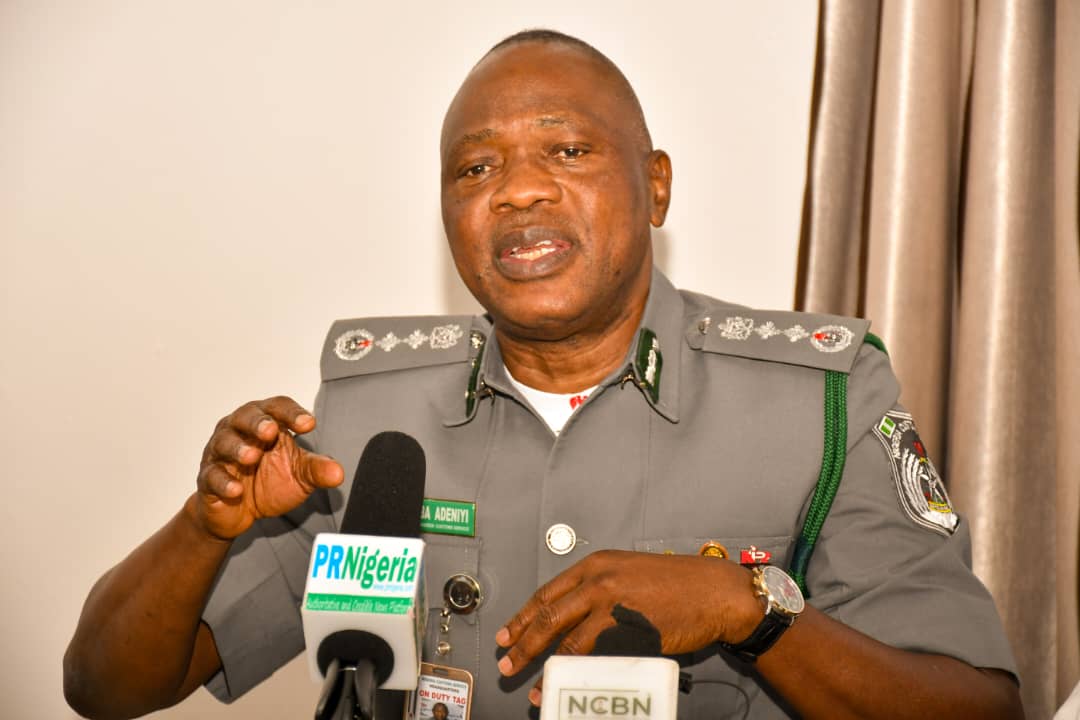
Do not blame the Customs. President Tinubu has raised the 2025 budgets by a whooping N4.5 trillion and explained it singularly to expectations from increased or increasing revenues from the Nigeria Customs Service. The coincidence of the two developments or announcements simply explains where the 4 percent emanated from and absolves the Wale Adeniyi led Customs management of blame.
From antecedents, no hoopla, no writing, no demonstration, or remonstration will make any meaning or impact. Do not blame the Customs.