
Nigerian Shippers’ Council calls for outright removal of War Risk Insurance premium on Nigeria

The Executive Secretary of the Nigerian Shipper’s Council, Dr Pius Akutah, says the cost implications of the war risk insurance premium on vessels that come to Nigeria are too burdensome on the national economy.
Akutah, however, called for the downward review or outright removal of the insurance premium, assuring Nigerian shippers of continuous protection of their interests as the Ports Economic Regulator.
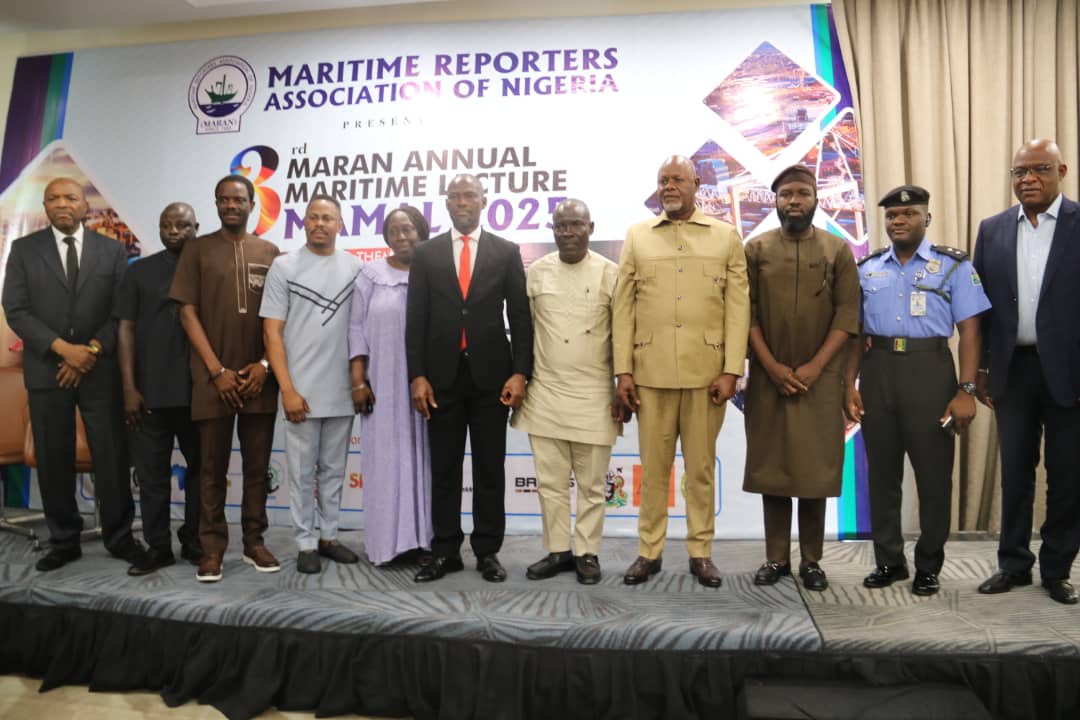
He joined other voices against the premium while speaking at the third MARAN Annual Maritime Lecture, “MAMAL 2025” with the theme “Addressing the Burden of War Risk Insurance on Nigeria’s Maritime Trade” in Lagos. The lecture was organised by the Maritime Reporters Association of Nigeria (MARAN).
The Executive Secretary who was represented by the Director, Regulatory Affairs of the Council, Mrs Margaret Ogbonna, noted that in recent years, Nigeria, through the concerted efforts by the Nigerian Maritime Administration and Safety Agency, NIMASA, and the Nigerian Navy, as strategic partners in regional and international borders, has recorded significant reductions in piracy and armed robbery attacks at sea.
According to him, it was as a result of the sustained investments in the maritime domain, improved inter – agency cooperation, deployment of the Deep Blue Project and Nigeria’s fair commitment to uphold the safety and security in the maritime environment.
Akutah noted that despite these giant strides Nigeria remains unfairly classified as a high risk shipping zone, thereby attracting exorbitant war risk insurance premium surcharge. “Forcing the importers and exporters to pay so much money when so much money is needed by the people, in the form of war risk insurance, is not what can be ignored further as these costs have ultimately been transferred to the businessmen hence the reason behind inflating the prices of goods and undermining the competitiveness of maritime trade,” he said.
Related Posts

The Shipper’s Council boss explained that, as the Economy Regulator and a strong advocate for the protection of the shippers interest, the Council would consistently campaign for the review downwards or outright removal of the war risk insurance surcharge while also pledging the Council’s firm belief that, the continued imposition of the surcharges which are no longer justifiable, given the improved security matrix and Nigeria’s demonstrable commitment to safe shipping.
He expressed optimism that, based on a report reaching him, efforts are being made towards a robust engagement with the international Underwriter, Lloyds Marketers Association and local counterparts to advocate a data driven re – assessment of the risk status of the Nigerian waters.

He also re – stated the Council’s plan to engage with NIMASA and the other Agencies, to compile and present an empirical evidence that really reflects the current security reality in the nation’s maritime domain.
According to Dr Akutah, the Council fully supports the ongoing discussions at the ECOWAS, the Gulf of Guinea Maritime Collaboration Forum and at the International Maritime Organisation (IMO) Platform, all aimed at securing the recognition of Nigeria’s achievements and the need for a fairer treatment by the global Shipping and Insurance Community.
Moving forward, he further pledged to recognise the fact that addressing these challenges requires constant collaboration between the Government, Private Sector, the Media and the international Partners hence applauding MARAN for the initiative.
He reaffirmed the fact that, the Nigerian Shipper’s Council would not relent in its advocacy for the removal or downward review of the war risk insurance premium surcharge hence his promise to stand firmly with the Nigerian Shippers and all Ports Users, in ensuring that the costs of doing business in the nation’s Seaports reflect the reality not outdated perceptions while also reiterating the Council’s commitment towards building a cost efficient, secure and competitive maritime sector that supports the Nigeria economic growth and trade development thus commending MARAN, for its unwaivering dedication to the growth of the nation’s maritime industry.