
NRC MD unveils plans to link all seaports to railway

By Gboyega Oni
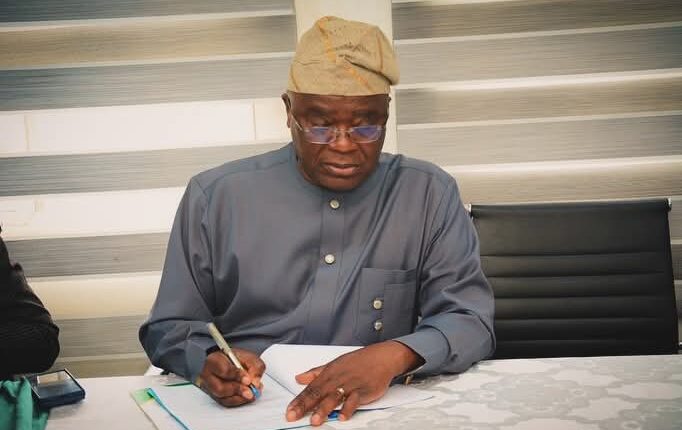
The Managing Director of Nigerian Railway Corporation (NRC), Dr Kayode Opeifa, has unfurled a development package that entails a rejig and relink of all abandoned hinterland railways and a comprehensive railway network of all Nigerian ports across the eastern corridors of Warri ports to the city of Warri itself in a bid to enhance transportation of cargo in and out of Nigerian ports.
Opeifa made this declaration on a TVC News Breakfast programme on Thursday, August 7, 2025 where he addressed the issue of restoration of train services in Jos and the surrounding regions.
On the resumption of train service in Jos, Opeifa said the people of the city were excited about the service. “On the issues of feedback, the feedback we are getting is that the people of Plateau specifically want the train to run as far as Kuru. In fact, the government wants us to push further to Kuru.”
The Managing Director noted, however, that NRC management had to slash transport fares and run below operational costs so that the people could enjoy the dividend of democracy as directed by President Bola Ahmed Tinubu.
He added that the Service might likely be in Kaduna before the end of the year. ” We are looking at being in Kaduna before the end of the year. Apart from the light rail system the state government is working upon, we are also working on running some train services in Kaduna state, within the metropolis of Kaduna and Zaria,” he noted.
“There is also a plan to connect all the seaports in Nigeria. The train currently gets to Apapa Port both narrow-gauge and standard. The Tin Can Island Port will eventually get connected. Same way, the Warri Port will be connected to Warri on the central line. That is Warri Port to Warri Town.
“On our freight level, rail by freight revolution, almost 99% is by PPP arrangement. One company has its own equipment running on a line of freight. We also have about 10 to 20 other logistics companies who partner us to move their cargo from the Lagos Port Complex.

“We also have the APMT, one of the major terminal operators in Apapa, also involved. They use our corridors, they use our wagons to move on their own cargo. So, on the freight side, because of the short profitability, the private sector is fully participating,” said he.
On the funding of all these rail projects, Opeifa admitted that funding is a major issues globally but the corporation would need continuous financial support from the government to back up its projects.
According to him, “the issue that is left is funding. Funding issues, yes, like every other part of the world, we look forward to continued support from governments and government managers of funds to understand that rail transportation or, in general, land transport system or intercity, interstate transport system are always priority for government because they provide not just socio-economic benefit, they provide security benefits and they serve as trade enablers. So that mainly is the area of issue now.
“To sustain, we need continuous budget stream to back up the services because the business people will pay more taxes at the end of the day because they make more profit. Civil servants, public servants, MSMEs will do better at work, improve productivity.
“We see on some of our trains, people are even playing chess. They are playing drafts, dancing and singing. They are happy. Those are the kind of feedback we are getting. And many states have also approached us to come and run rail service.”
On the national lines, Opeifa disclosed that there is a plan by the Federal Government to connect all major cities in all regions of the countryband this would be unveiled by President Bola Ahmed Tinubu before October 1.
Related Posts

Opeifa said “On the issue of the national line, let me tell you the plan of Mr. President, President Bola Ahmed Tinubu. There is a plan to connect major cities of this country. And we have seen that just now. Now, there is also a plan to expand the ongoing rail modernisation plan on the standard gauge.
“Very soon, most likely before October 1, there will be unveiling of many of the other new lines that are coming up. But I can tell you for sure that I see lines, connections to many towns and cities. There is a regional, what do you call it, the regional development commission too. They are also working on their own plan. What we are doing now is integrating all this plan with the national rail corridor.
“So there is a holistic plan and we are working with the state governments. And we appeal to most states to join. We appeal to the National Economic Council and the Forum of Governors to also show much more interest in this regard so that we can take the full benefit of the vast infrastructure within the National Corridor that is not being fully utilised,” said he.
On the future plan for enhanced rail services, the railway man informed of the plan to transit to renewable energy and fast trains in next 5, 10, 20 and 30 years
“So we have what is called the vision 5, 10, 20, 30. That is what we do in the first five years. How we transit to renewable energy in the first five years to ten years when we start going electric.
“And then the issue of fast train is also on the table in the five to ten year programme. So it is a massive programme and it will soon be unveiled. The infrastructure itself is very expensive to build,” said Opeifa.
On the use of train to move products of Nigerian farmers, Opeifa said the corporation had formed a partnership with Niger State government on use of rail to move farm produce to different to Lagos where there is a big population and market. He noted that the service would have started if not the flood that washed of track in Mokwa.
“Our partnership with the Niger State Government on railing with the state is actually focussing on moving farm produce from Niger State down to Lagos. And we have made substantial arrangements for them to have warehouses at Ido, Ebute Meta, Papalanto, and Jebba.
“We have a station that runs through Makurdi that runs through Lafia, and that will allow the people in those corridors to move their farm produce. And right now we have a waggon assembly plant in Nigeria, in Ogun State, and we are manufacturing waggons. We currently have waggons for Katu, we have wagons for reefers refrigerated wagons that can move milk,” said he.
To forestall racketeering and corruption in sales of tickets, Opeifa informed that the corporation had engaged Public-Private Partnership (PPP) model to sell tickets and these organizations have deployed electronic payment apps to checkmate this to a bearable level.
“The public-private partnership is the way to go and that is exactly what we are doing. But you have to demonstrate the capacity for the private sector to show interest. They have to be assured of return on investment. So we can’t wait for that to happen before we provide service.
“For example, on our ticketing platform for Abuja, Kaduna, Warri, Itakpe and Lagos, it is purely by PPP arrangement. The private entity is doing it, we don’t have any interaction with the ticketing system except that you book through our platform. So we have FAME, you have GSDS and you have Secure ID TPS who operate our ticketing platform.
“So we have moved from that issue of staff or other people profiteering, we have brought that to a minimum level. Because we are now using NIN, National Identification Number, before you can buy a ticket.
“It is painful, but that is one way we have been able to tame the challenge. However, we have also seen people who have stolen some individuals’ NIN numbers and they are using them to make multiple purchases but the PPP arrangement has reduced ticket racketeering,” according to him.