
SPECIAL REPORT: Port modernisation will attract bigger vessels to Apapa Port – Lawal
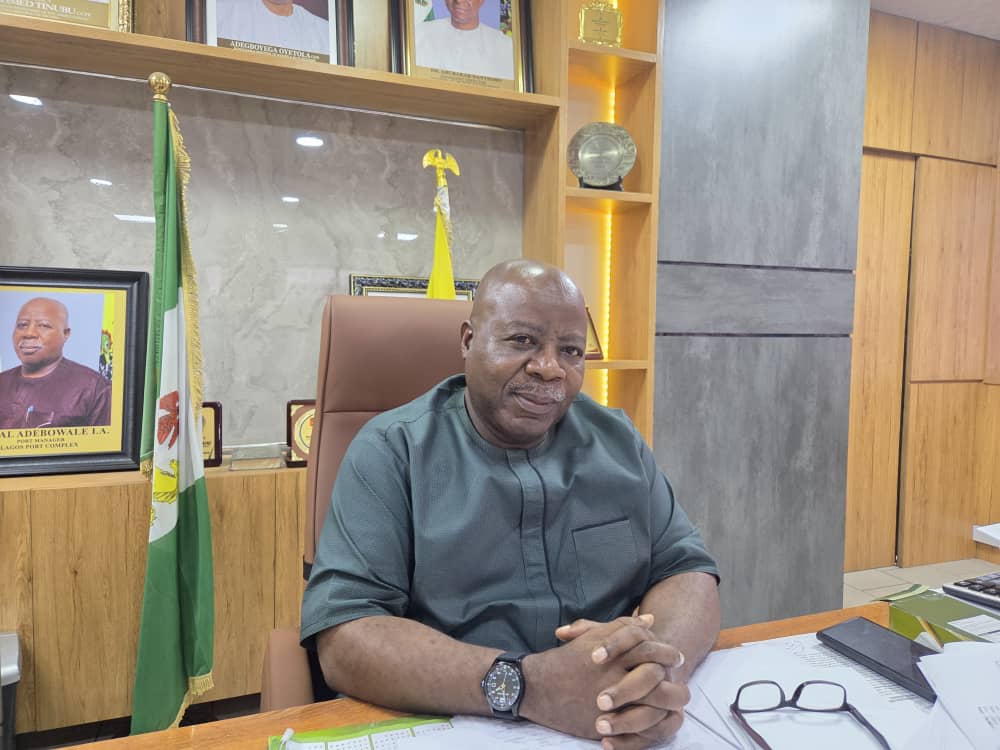

Mr. Lawal Adebowale Akano, Port Manager, Lagos Port Complex, is a reporter’s delight. He is suave, brilliant and knowledgeable about shipping and port industry administration. He lays bare his optimistic dispositions about the Nigerian Ports Authority, the industry and its stakeholders. In an exclusive interview with PortNews Deputy Editor, Adegboyega Oni, touching on the performance of the port, gains of port modernization and various issues about Port Operations. Here is the interview in full.
As the Port Manager of the Premier Port, widely regarded as having the largest Cargo throughput in West Africa, how would you describe your professional journey so far and the fulfilment that comes with it?
Luckily, we have a listening Management team led by Dr. Abubakar Dantsoho, which makes the job easier for us. You would have noticed that port traffic and access roads are now much better managed.
Why? If the access to the Port is not free of traffic, irrespective of the number of vessels that are coming to the Port to discharge their consignments, once you are not able to evacuate as they come in, there will be congestion. So that’s why we have to ensure that the Truck Management System is very effective now.
We recently reviewed the Port Traffic System to address the problem of “crisscrossing,” where trucks meant for one Terminal end up at another Terminal. We’ve put measures in place to reduce this by proper scheduling.
For instance, if a terminal requires 100 trucks daily, those trucks don’t all need to be on the road at once. They are now scheduled in batches, and the call-up system is strictly serialized. If you are number 10, you cannot bypass number 1 or 2 without a valid reason.
We are also seeking collaboration with the Lagos State Government to further improve truck movements. There are people that have no business with the Port, but work and live in Apapa, so we must ensure that residents and businesses in Apapa are not unduly disturbed by port traffic. Already, the improved road network has revived many businesses and if I want to go to my Head Office now, it will take me 20 minutes to get to my head office, and still be back to Lagos Port Complex.


I am sure before now, you can’t try that. So, those are the kind of things we are trying to do, which is a major thing. Like I said, if trucks don’t come in to evacuate whatever cargo vessels bring in, the port will be in a mess.
What you are saying so far is that the Eto Call-up system is working perfectly?
No, nothing is perfect. It is working greatly, and the system will continue to be reviewed from time to time because there is no body that is perfect. It is constantly reviewed to address challenges. In fact, today we went live on the latest review. If we discover teething problems, we will adjust accordingly.
Let us look at the performance of your port in the first half of the year 2025 from January to June. How can you rate the performance in terms of cargo volumes and number of vessels?
It is wonderful! Let me give you an example. We just had an operational meeting today (Monday, September 1, 2025), last week we did 9,000 containers, two weeks ago we did 9,000 but this present week we did 10,000+, we have a variance of 643 TEUs. So we keep improving by the day. While we are improving, the environment is getting better for vessels to come in and go back.
The management is trying to deepen the channels. There is a Port Modernization coming up so that much bigger vessels will come in. Those are the things we are taking care of. More navigational aids are being put in place because we need that for bigger vessels to come in.
In terms of the number of vessels, how many vessels did you welcome between January and June? We started the second quarter in July, July to September 1st, what was the level of performance in terms of Cargo volumes and number of vessels?
Based on the Federal Government directives to prioritize exports, we now have dedicated export lanes into the port, as well as Export Processing Terminals (EPTs) such as Diamond Star and Bellington in Ijora.
We schedule 15 trucks per batch for every EPT. If there are seven EPTs doing four batches daily, that means about 425 export trucks come in daily.
What other incentives do you give exporters?
Export cargoes are given priority to ensure that they get into the port on time and they are loaded on time. We also encourage terminals to evacuate empty containers promptly and to handle exports especially perishables with urgency. Exports should not remain in the port for more than five working days, otherwise they risk spoilage and reputational damage to Nigeria.
Take yams, for instance. Many Nigerian yams end up being rebranded as “Ghana yams” simply because they were routed through other ports. By ensuring exports leave Nigeria promptly, we protect both revenue and national image.
In August alone, we handled 21,070 TEUs, alongside 389,022 metric tonnes of general cargo – a significant improvement compared to the congestion of last year. With the Christmas season approaching, we expect even higher volumes.
What were the challenges you encountered in the first half of the year and down to now?
If I have to be honest, we didn’t really encounter any much challenges, except, this is just maybe our Nigerian factor where people are a bit careless.
Let me say it here, Cargoes are ready to be cleared, Customs releases the Cargo, but you’ll find that agents are not available to take their containers out, then they turn the port into a storage thereby creating problems for us. Those are the kind of problems we have. If everybody realizes that they have a responsibility by playing their part, it will really take us a long way to achieving great success.
We once had a case where a container stayed 30 days after clearance. When penalties are applied, owners start protesting. This attitude creates unnecessary problems. . Some clearing agents abandon released containers in the port for weeks, turning it into a storage yard. The port is not a warehouse – it is a transit point. Your cargo should come in, get cleared, and exit.
Related Posts

Do vessels have easy berthing?
I think they will start that (Port Modernization) before the end of this year. They have done what we call wells on berth one to 15. They have done the wells to start the process of doing the reconstruction of the quay parts.

Will it not affect Terminal Operators?
When the Port Modernization starts, it will not in any way affect cargo discharging or cargo delivery by terminals, it is not meant to affect their operations. The whole 16 berths will not be done at once, there is no reasonable authority that will do that. They will pick them berth by berth. When we start from berth one, it will just be demarcated and allow operations to continue in other berth.
You can’t close down commercial operations because you want to carry out modernization. We are going to give them the schedule of the construction so that they will also plan ahead.
We are also going to tell them this is the period we will do this and this is where we will start from. We do meetings and they are always invited for the meeting with the construction company.
Before Port Concession, the Nigerian Ports Authority (NPA) was in charge of vessel and cargo handling operations. What roles does NPA play now since concessionaires are now in charge of cargo operations?
We are still in charge of marine services. What do I mean by marine services? We still provide piloting services for vessels and also pick their waste.
How have you been able to assist APM Terminals in the movement of cargo by rail from the port down to Kano?
I know they also move cargo to Moniya in Ibadan. If we don’t want them to move those boxes, we would not allow the rail line to be built within the port. Transportation is meant to be by water, land and rail, so we have to integrate all of them. You can’t leave one out of the three, if not, we are not a modern port.
The Moniya terminal was just launched. They take about 60 boxes every Wednesday and Friday to Moniya, Ibadan. So we try to encourage them. We also encourage the barging of cargo through water. Using rail and barges reduces pressure on the roads and makes us a truly modern port.

Can you say you are satisfied with the barging operations because some of the barges in operation are very old?
Let me give you what one of my former Managing Directors said. “I want to get to Ibadan, it doesn’t have to be through Mercedes, and it doesn’t have to be through first class vehicle. A Volkswagen Beetle could take me to Ibadan.” And when you consider the value of the amount these people get these barges, it’s not cheap, like I said, nothing is perfect, and nothing is 100%.
Some barges are indeed old, but operators are still helping us reduce road pressure. We are engaging them to collaborate more, pool resources, and acquire world-class barges. For now, they are doing their best.
As the Premier Port, what is the level of your collaboration and relationship with the Customs, terminal operators and others including Custom agents?
I think I’m a bit lucky to have this set of government agencies who I’m working with. To show the level of collaboration, if I call the Customs Area Controller of Apapa to make enquiry on any operational issues, he will not hesitate answering me or even come to my office. This applies to other agencies and terminal operators. It shows you the kind of collaboration we all have here. That’s the truth.
Port concessionaires, since taking over of cargo operations in 2006, have not been transferring containers to private bonded terminals around Lagos. Is there not a need for cargo allocation to them?
I was just told recently. And I want to know why they don’t move boxes to those other terminals. Because if they can move to Kano, although it is their own, but they also move boxes to Moniya in Ibadan, which is not their own.
So I want to know why they are not moving boxes to Sapid, Migfo and others within Lagos area. I will engage them on that and find out why those boxes are not being moved there. Because if you can move to Moniya and Kano, you should be able to move to some of these places. We don’t want congestion within the port, and that will also reduce the pressure on the road because that is the means of distribution. It will reduce number of people coming to one location. So if your cargo is being distributed outside the port environment, it will reduce the number of people coming to Apapa.
Many of these terminals are empty
I know. I have seen Migfo and others. So if we can encourage them more to take those cargo containers there, then less pressure here. People will pick up their cargo from that side. So I will engage them on this matter.

In summary, Port Manager Lawal Akano believes the Lagos Port Complex is on a steady path of growth and modernization. With better traffic management, export prioritization, rail and barge integration, and ongoing modernization works, Apapa port is positioning itself to handle bigger vessels and higher volumes while easing pressure on surrounding communities.