
States highlight major obstacles in National Policy on Blue Economy, demand directions for domestication

Gboyega Oni
One of the vehicles targeted by the Federal Government to make Nigeria a one trillion dollar economy by 2030s is the Marine and Blue Economy sector. So is the reason why President Bola Ahmed Tinubu created the Ministry of Marine and Blue Economy to drive and harness the economic potential in the sector.
Driving this is the National Policy on Blue Economy approved by the Federal Government and saddled the Federal Ministry of Marine and Blue Economy, whose scope has been expanded to fisheries and environment that used to be under the ministries of agriculture and environment, and the litoral state governments to implement it.
Many litoral states have keyed into the policy as Bayelsa State created the Ministry of Marine and Blue Economy and even appointed a commissioner. Ondo State is yet to name a ministry in charge of Marine and Blue Economy but the governor has a special adviser on Marine and Blue Economy and even working to make Olokola Deep Seaport a reality as President/Chief Executive of Dangote Industries Limited, Alhaji Aliko Dangote, visited the State Governor, Lucky Orimisan Ayedatiwa, to consolidate this. As a rider to this, Governor Ayedatiwa also set up a committee to tidy up and facilitate the deep seaport.
Even the Akwa Ibom State established the Ministry of Internal Security and Waterways and driving the Ibom Deep Seaport Project as its flagship blue economy initiative.
Despite these efforts by these litoral states and others showcasing their readiness for the sector, a lucana has been identified in the National Policy on Marine and Blue Economy – lack of guidelines for domestication by the states.
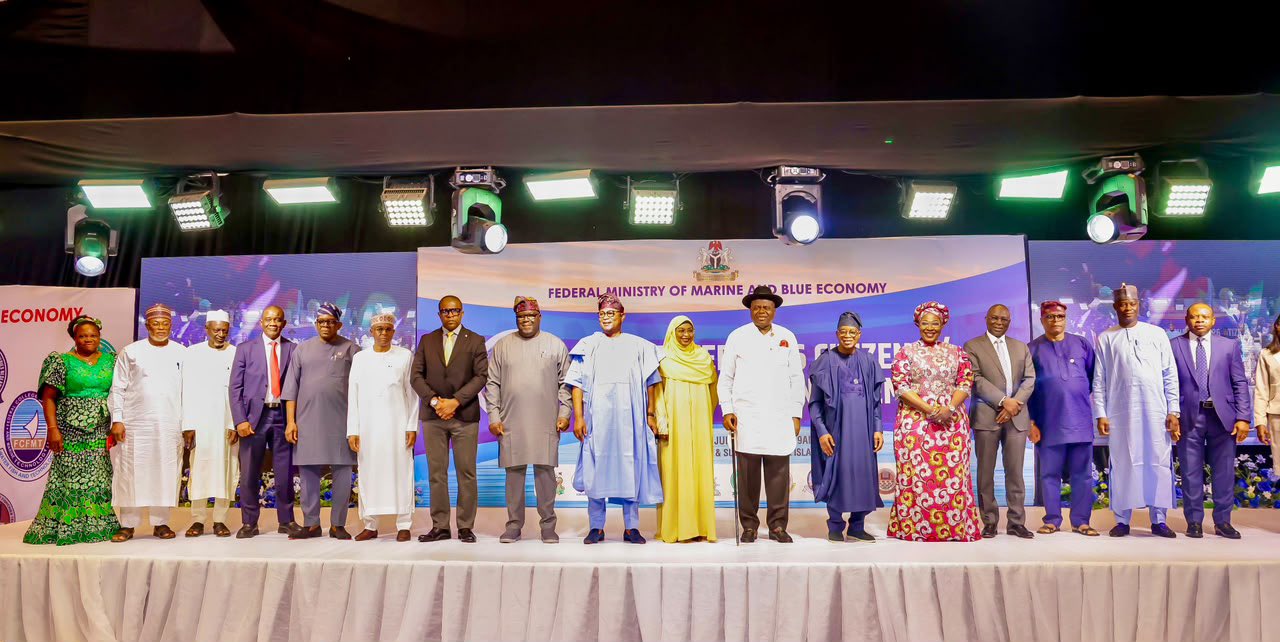
Speaking as the representative of Ondo State Governor at the Second Quarter 2026 Citizens and Stakeholders’ Engagement of the Federal Ministry of Marine and Blue Economy in Lagos on Thursday, July 2, Engineer Olu Aladenusi, Special Adviser to the Governor on Marine and Blue Economy, pointed out this lacuna, saying that there are no instruments or directions in the policy to empower states to domesticate it. He added that there is no push and support from the Federal Ministry for the states to do this.
Aladenusi, who was a former Director of Safety Department at the Nigerian Maritime Administration and Safety Agency (NIMASA), said another major obstacle is the refusal of the ministries of agriculture allowing their fisheries departments to join the Marine and Blue Economy as stated in the policy, demanding for the directives that mandated them to do so.

According to Engineer Olu Aladenusi, “This is a wonderful gathering. We are happy to have this, but today’s assembly is very important. I want the Minister of Marine and Blue Economy to know that all the litoral states that are supposed to be implementing the National Policy on Blue Economy don’t have enough support from the Federal Ministry of Marine and Polar Economy.
“Why do I say this? We are in the markets, we are seeing the Minister, we are seeing everybody, NIMASA is here and everybody is here. Our Senator is here. This policy is long overdue.
“I was in NIMASA as Director of Safety Department. I was exited and I got this appointment with the State Government.
“We have been looking for this (policy). Today we have it. We have been trying to domesticate this policy in the states, but there is no way. There are a lot of openings now. At the Federal Ministry of Marine and Blue Economy, we have the Fisheries Department coming to the Marine and Blue Economy.
“At the state levels, everything is open. The people that are from the fisheries department are refusing to come out and ask for the document. Where is the document from the Federal Ministry that gave this permission? Several times I called my sister from Bayelsa State seeking advice from her on how Bayelsa State did it.
“How do you advance society? We have to domesticate this policy at the state levels. Then the instrument, the push from the Federal Ministry for us to do this is not in place.”
Related Posts

On the way forward, Aladenusi submitted “We are asking for the policy guidance from the Ministry of Marine and Blue so that we can have a pathway at the state levels. So that our path will be very smooth.
“This is very, very important. I want the policy thinkers and the Minister of Marine and Blue Economy to please assist the states because everybody wants to sit on a function. The ministry of agriculture does not want to leave the fisheries department.
“The environment doesn’t want to leave anything that has to do with other environment management. So if you have a straightforward guide that will guide the states, we know where to go.”
Also speaking, the Deputy Governor of Akwa Ibom State, Senator (Dr.) Akon Etim Eyakenyi, who represented the Governor, commended President Bola Ahmed Tinubu for his foresight behind the creation of the Ministry of Marine and Blue Economy, saying it is a bold step in taking full advantage of the enormous wealth embedded in our waters.
The Deputy Governor enumerated various efforts by the Government of Akwa Ibom State to drive blue economy such as the establishing the Ministry of Internal Security and Waterways, the Ibom Deep Seaport Project is our flagship blue economy initiative.
According to her, considering the contributions of marine and blue economy to the wealth of nations, it is heartwarming that our country is expediting action towards taking full advantage of the enormous wealth embedded in our waters.
The establishment of the Ministry of Marine and Blue Economy is one of the manifestations of his (President Bola Ahmed Tinubu) vision and astuteness as a leader. The Minister of Marine and Blue Economy, His Excellency Adeboyega Oyetola, deserves commendation for his ability to accurately interpret the Renewed Hope Agenda in the Ministry of Marine and Blue Economy.
“The marine and blue economy sector has a significant role to play in Nigeria’s quest for economic diversification and sustainable development. The fact that over 90% of our international trade is routed through the waters reinforces the importance of this sector to the national economy.
“As a major maritime state in Nigeria with a coastline measuring about 129 km contiguity to the Atlantic Ocean and strategic location in the southern edge of the Gulf of Guinea, the marine economy potential of Akwa Ibom State is not a matter of conjecture. So, we have a duty to fully embrace the reforms introduced by the Minister of Marine and Blue Economy and all actions geared towards helping our nation benefit maximally from this sector. The process for domestication of the national policies on marine and blue economy in our state is ongoing and through this the Arise Agenda of the state will find its fulfilment.
“First, upon adoption of office in 2023, we prioritise the safety of our waterways by establishing the Ministry of Internal Security and Waterways for the first time in the state. We went ahead to donate 14 patrol gun boats to the Nigerian Navy and other marine-based security agencies to combat sea piracy, kidnapping, smuggling and other criminal activities in our waterways. The Ibom Deep Seaport Project is our flagship blue economy initiative.
“The project has advanced from planning to detailed feasibility studies. The state government is working with investors and technical partners in order to move to the long-awaited implementation phase. To add to that, I want to appreciate the Honourable Minister on behalf of the government for all your support.
“An audacious maritime hub project comprising a modern marine terminal, a passenger ferry terminal, two passenger ferries, a jetty, a warehouse, a coal room, shoreline protection works and recreational facilities has reached an advanced stage of completion in all local government in Akwa Ibom State. Upon completion, this project will redirect part of the maritime traffic in the South-South region. to Akwa Ibom State.
“We are determined to contribute our quota to the national economy through the maritime sector. (This is why the ARISE Agenda identifies marine and blue economy as a strategic sector for the actualisation of a plan for economic diversification, employment generation, wealth creation, and sustainable development. Our state is a willing and ready partner with the federal government in this regard.”
The engagement, themed “From Policy to Action: Mobilising Sub-National Governments for Effective Implementation of Nigeria’s National Policy on Marine and Blue Economy,” brought together government officials, diplomats, development partners, industry leaders, academics and representatives of state governments.