
Dr Opeifa: Modernizing Nigeria Railways Operations for Economy’s Devt
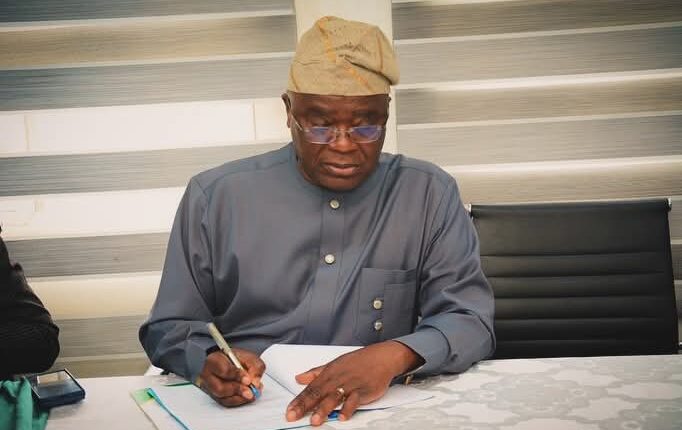

There have been strong indications that the rail sector of the Nigeria’s economy would soon be fully modernized, sequel to the series of measures which the Dr Kayode Opeifa- led management have been adopting to enhance the development of the Nigerian Railway Corporation(NRC) and modernize the rail sector of the economy.

With the series of reforms he has been putting in place since his appointment as the helmsman of the Railways, Opeifa has thus brought back the memories of his achievements as the Special Adviser and later Commissioner for Transportation, years ago , under Governor Raji Fashola, when he re-organised the Transport system in Lagos, later , as the Secretary of Transport in the Federal Capital Territory (FCT) , sequel to his appointment to the position, by the late President Muhammadu Buhari.
In fact, it was the outstanding impact he made on the transport system in Abuja that made President Buhari to again appointed him as the Vice Chairman of the Presidential Task Team to successfully tackle the very nagging congestion on the access roads, leading to the Seaports in the South West – Apapa and Tin Can.
An Academic, who has been devoted and committed to excellence in the field of transportation, his stint as a lecturer at the Lagos State University (LASU) and his membership of the Board of the NRC for about five years before his appointment as the MD, inclusive of the positions he has held have all combined to deepen his knowledge, experience and capacity, to add value to the NRC’s operations, within a very short period of time of his appointment.
To appreciate the extent of the impact he has been able to make, it would suffice to take a peep into the details of the mandate that was given to him by the Federal Government and the reforms he personally pledged to put in place when he was named as the MD of the NRC.
While Dr Opeifa’s appointment reflects President Tinubu’s commitment to selecting skilled professionals to execute his “Renewed Hope” agenda, focusing on infrastructure development and economic growth, investigation showed that the Federal Government’s gave him mandate to modernize the nation’s railway network, drive innovations, enhance trade, commerce and national development.
Dr Opeifa also on his own on his assumption of duty, promised to modernise and deepen national rail system to connect all the states of the federation, prioritize the welfare of the corporation’s workers to pave way for the realization of ‘The Renewed Hope Agenda’ provisions, carry along the management and workers of the corporation to focus on efficiency, safety and customer satisfaction, that is driven by passion and excellence among other promises.

In fulfilment of his mandate and his personal pledge to enhance workers welfare and his recognition of the fact that the personnel constitutes the engine of growth of an organization, Dr Opeifa has made significant strides in improving workers’ welfare and capacity building in the NRC in many ways than one.
He has approved the implementation of 95% Pay to the personnel, a development that has been a significant boost to their welfare and even pledged fresh improved welfare packages for the workers, emphasized accountability and professionalism as well as introduced modern vocational training programmes, including welding, solar technology, and mechanics, thus expanding human capacity.
In his bid to effectively fulfil the mandate of revitalization of rail infrastructure, one of the first steps he took was to inspect the state of facilities in the three districts of the Railways, identified the infrastructure to be fixed or replaced, following which he mapped out strategies , which led to the repairs of the affected rolling stock.
In ensuring the enhancement of human capacity, his management has been annexing the competencies of the abundance of a crop of well -trained young professional engineers, who have acquired knowledge through the partnership of the Nigerian government with the Chinese, via its Chinese Civil Engineering and Construction Corporation (CCECC).
The management has thus been maximizing the potentials of these young engineers to remodel and retrofit coaches and locomotive engines, fix train tracks, thereby building capacity within the NRC and aligning with President Tinubu’s Renewed Hope Agenda for the railways.
Under this initiative, NRC has been leveraging narrow and standard gauge access to the Lagos Port Complex to deepen trade between northern and southern Nigeria, as this has seen a consistent boost in movement of goods from the Ports to the Northern part of the country, thus reducing the cost of goods, easing pressure on roads and improving national productivity and GDP.
The various collaborations and renewed partnerships which Dr Opeifa has entered into with many companies , such as terminal operators, logistics companies, and manufacturing concerns, have resulted into a consistent increase in the number and volume of goods ,containers and bulk cargoes , like cement, gypsum, soda ash, and coils being transported by rail from the ports.
While damages and stealing of NRC Assets have for long characterized the Corporation’s operations before the advent of the current Opeifa – led management, though such still happen at reduced level , but Opeifa has however been very forceful and efficient in its handling of the issue in other to effectively put a check to it.
This approach has included the management’s collaborations with Security Agencies such as the Nigeria Police Force, Railway Command, and the Nigeria Security and Civil Defence Corps, a development that has led to apprehending and prosecution of vandals and thieves who have vandalized and stolen the NRC’ assets.
Related Posts

The Opeifa-led management has constantly been tracking and recovering stolen rail assets in conjunction with the security agencies in particular the Nigerian Police. For example, in one instance, two suspects were arrested with stolen cable wires, and over 70 iron sleepers were seized while many rail components and that would have otherwise be lost have been recovered.
The current management has also been organizing sensitization campaigns across the country targeting scrap metal dealers to curb the purchase of stolen railway materials, prioritizing the protection of railway infrastructure.
In adherence to the Renewed Hope Agenda’s initiative and to build capacity, his management has embarked on the continuation of all ongoing standard gauge projects, construction of new standard gauge lines, and sustainable rehabilitation of the legacy narrow gauge lines with spurs to food and industrial hubs, a development that has facilitated trade and investment and brought down the cost of food, goods, inflation, and business.
For instance, the NRC is set to fully restore commercial train services on the Lagos-Kano narrow gauge corridor to Offa, Minna and Kaduna as the tracks have been fully reactivated as part of plans to boost connectivity across Nigeria with significant investment committed to infrastructure and modern stations, boosting trade and commerce.
The Corporation has also been working towards the full reactivation of the Lagos–Kano–Baro narrow-gauge line to enhance freight and cargo movement, support state rail projects and boost national mobility, particularly for agricultural produce.
He has also embarked on the repositioning of national rail services, including the Abuja–Kaduna, Lagos–Ibadan, Warri–Itakpe and Port Harcourt–Aba train services.
Thus, the huge investments of the Nigerian government in rail development which the current management has continually harnessed in the past months has led to improved service delivery and greater operational efficiency of the rail sector, even as the NRC plans fresh rail developments that would cut across the six geo-political zones of the country, under the Renewed Hope Agenda.
As part of plans to enhance customer satisfaction, the NRC has signed a Memorandum of Understanding with the Presidential Initiative on Compressed Natural Gas (PI-CNG) to reduce diesel dependence and operational costs, ensuring reliable, efficient, safe, and sustainable railway services.
Dr Opeifa has through the NRC’s Track Access Programme (TAP), effectively followed up on the enforcement of NRC’s removal from the Exclusive list to allow the States and private sector to utilize existing rail lines for mass transition programmes and expand the rail system nationwide.
In this light , the NRC has continued to support Lagos State through its agency, Lagos Metropolitan Transport Authority (LASTMA) to succeed on its Red Line and Blue Lines project ,having being part of the TAP while it has made it possible for Plateau State under its “Railing on the Plateau’ initiative and Niger State’s agricultural transport system and the CCECC, for purpose of freight operations, to have all keyed in to the initiative , as more states are gearing to seize the opportunity.
This is why the Corporation has commenced the Jos-Kuru line as part of the commitment and partnership of the Plateau State government with the NRC to ensure the utilisation of the rail system in the state.
Apart from States that have keyed into its TAP, others who have shown interest include Ogun, Bauchi, Niger, and Borno, even as some regional development commissions have shown interest in investing in the rail sector.
These efforts aim to further reduce transportation costs, increase GDP, and provide food security for a larger part of the population aligning with the Federal Government’s Renewed Hope Agenda.
Also as the NRC continually collaborated with the Federal Ministry of Transportation (FMOT) to revitalize the rail system, with its forward looking initiatives, it is likewise set to put in place a National Rail Development Plan having a fully modernized NRC, which operations would have connected all parts of the country with better impact on the economy by 2027 and beyond.
For instance, the management plans to have completed by 2027, ongoing rail infrastructure projects, such as the Eastern rail line and other significant investments which would surpass the total investment in the rail sector in the past 60 years and further boost the rail network in the country.
The management is also planning to introduce high speed trains into Nigeria within the next five years from now, contingent on private sector investment and government support.
Thus, in view of the rate at which the NRC current management has been upgrading existing infrastructure, including refurbishing abandoned locomotives and coaches coupled with other reforms that it has been enunciating , it is expected that the rail service will be better transformed more reliable, efficient with additional capacity to boost economic development very soon.
Shola Fadeyi is a Lagos based consummate journalist, Publisher of Marine and Economy and MD Simofad Communication