
TAAM: Oyetola commends SIFAX Chairman’s support for youth development
Nigeria’s blue economy is a sleeping giant waiting to be tapped - Afolabi

The Minister of Marine and Blue Economy, Adegboyega Oyetola, has paid a special tribute to Dr. Taiwo Afolabi, Chairman of SIFAX Group, over his legacy in business and youth development which has inspired excellence in the maritime sector.
The Minister said Afolabi’s vision reflects the important role of private sector leadership in driving innovation and economic transformation.
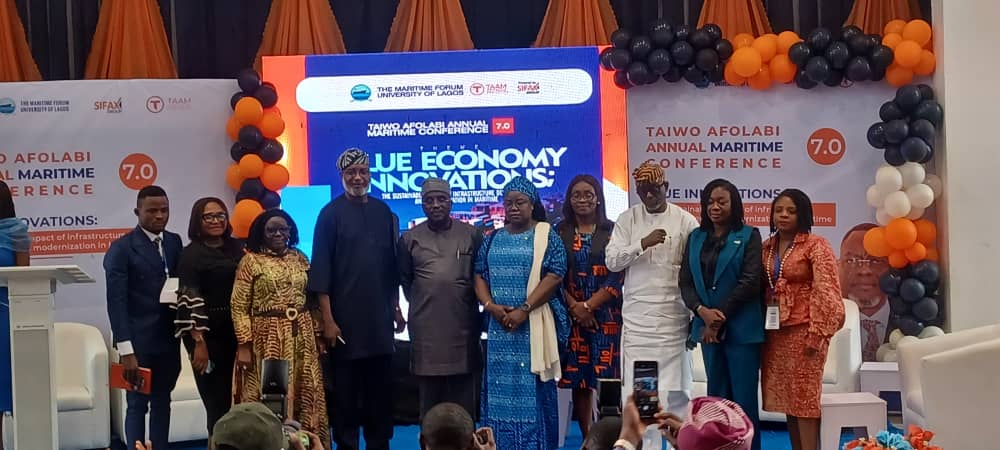
Oyetola paid this tribute on Friday July 4, 2025 while speaking at the 7th Edition of Taiwo Afolabi Annual Maritime (TAAM) Conference at the University of Lagos.
The Minister, who was the special guest of honour, commended the SIFAX Group and The Maritime Forum, University of Lagos, for sustaining this valuable platform for policy reflection and intellectual engagement.
Oyetola, represented by Mrs. Mercy Ilori, Director, Maritime Services, Ministry of Marine and Blue Economy, said the theme of the conference, “Blue Economy Innovations: The Sustainable Impact of Infrastructure Development and Modernisation in Maritime,” was apt timely and thought-provoking.
According to him, “it (the theme) challenges us to examine not only what we build, but how we build, and how innovation and sustainability must shape the maritime economy of the future.”
He said the establishment of the Federal Ministry of Marine and Blue Economy by His Excellency, President Bola Ahmed Tinubu, GCFR, represents a bold institutional reform to position Nigeria’s vast marine and coastal assets as pillars of national development. “To give structure to this vision, the Federal Executive Council has approved the National Policy on Marine and Blue Economy, which provides a coordinated framework for unlocking opportunities in ports, fisheries, ocean governance, marine biotechnology, renewable energy, coastal tourism, and climate resilience.
“In line with the theme, we recognise that innovation is not limited to technology; it also includes new thinking in infrastructure design, environmental safeguards, service delivery, and partnerships. The Ministry is currently advancing the Western Ports Rehabilitation Programme, including the reconstruction of Apapa and Tin Can Ports. Procurement processes are ongoing for the Eastern Ports. These physical improvements are being complemented by digital systems such as the Port Community System and the One-Stop-Shop platform, which are already improving efficiency and reducing delays.
Related Posts


“We are also reviving the National Carrier through a public-private partnership model, while NIMASA is preparing to disburse the Cabotage Vessel Financing Fund (CVFF), to enhance indigenous shipping capacity. Digitisation across our agencies is yielding positive outcomes in revenue growth, transparency, and service delivery. Investment interest is increasing in dry ports, bonded terminals, warehousing, and hinterland logistics, consolidating Nigeria’s emergence as a regional maritime hub.
“The Ministry is equally committed to ensuring that the sustainability dimension of infrastructure modernisation is not overlooked. As we grow the sector, we are prioritising environmentally responsible development by making our ports more energy-efficient, cutting carbon emissions, and adopting sustainable practices that minimise waste and promote the reuse and recycling of resources across the maritime value chain. Our infrastructure investments are increasingly guided by environmental and climate considerations.
“On the security front, the Deep Blue Project has significantly improved safety in our waters. For three (3) consecutive years, Nigeria has recorded zero piracy incidents in its territorial waters. This has stabilised the Gulf of Guinea and earned Nigeria commendation from global partners. Building on this achievement, Nigeria’s offer to host the African Union Combined Maritime Task Force in Lagos has been endorsed by the AU Peace and Security Council. Furthermore, Nigeria has formally launched its campaign to secure a Category “C” seat on the International Maritime Organization (IMO) Council. This move is not just symbolic: it reflects our ambition to contribute to shaping global standards on maritime safety, environmental protection, and technological innovation.
“As we look ahead, we must embrace frontier technologies. Marine robotics, for example, has the potential to transform underwater surveillance, infrastructure inspection, and ocean monitoring. I urge our universities and young professionals to drive local research and development in this area. The Ministry is eager to engage with academia and innovation hubs to co-create solutions. We welcome partnerships that can accelerate knowledge transfer, industry application, and indigenous innovation,” said the Minister.
“The Federal Ministry of Marine and Blue Economy is committed to a maritime future that is resilient, inclusive, technologically advanced, environmentally responsible, and globally competitive. By fostering strong collaboration among academia, industry, and government, we can collectively turn this vision into reality,” he restated.
Earlier in his address, Dr. Taiwo Afolabi, Chairman of SIFAX Group, said the conference is a synergy between The Maritime Forum, an association of the University of Lagos law students with bias for the maritime industry, and SIFAX Group, the company that has put its resources behind this event since inception.
Appreciating the Minister for gracing the event, Afolabi said “Nigeria’s blue economy is a sleeping giant. We have untapped potential along our vast coastline that, if harnessed responsibly, can create new jobs, strengthen our ports, attract investments, and safeguard our environment for future generations.
“The key objective of this annual conference is to create an intelligent and knowledge-driven platform that will bridge the gap between the industry and the ivory tower; between theory and practice, as well as facilitate an enriching networking opportunity between the students and key industry players.
“We wanted students to see what lies beyond their textbooks, to ask bold questions, and to connect directly with those shaping policy and driving change. I am proud that today this vision continues to grow, and that this platform has become one of the most respected gatherings for maritime discourse in any Nigerian university.”